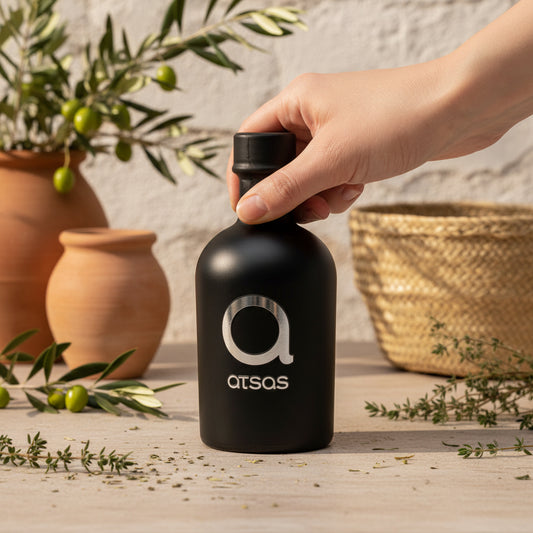
The Science Behind High-Polyphenol Extra Virgin Olive Oil
ATSAS is naturally rich in polyphenols — plant compounds valued for their antioxidant properties. This page brings together the science, the EU-recognised health claim, and the evidence behind our high-polyphenol extra virgin olive oil.
Why ATSAS Is Different
ATSAS extra virgin olive oil is produced from organically grown olives in Cyprus, cold-pressed to preserve the full spectrum of naturally occurring polyphenols. Our focus on careful harvesting, small-batch production and independent laboratory analysis means every bottle delivers consistently high polyphenol levels — not just a premium label.
ATSAS is available as a traditional extra virgin olive oil, as a daily food supplement shot, and in beautifully presented gift sets — making it easy to include in any routine.
The EU Recognised Health Claim
This is one of very few food-specific antioxidant claims recognised under EU nutrition and health regulation — and ATSAS is produced with this standard in mind.
"Olive oil polyphenols contribute to the protection of blood lipids from oxidative stress."
This claim applies when the olive oil contains at least 5 mg of hydroxytyrosol and its derivatives per 20 g of olive oil, consumed as part of a balanced diet. ATSAS is produced to consistently meet and exceed this threshold.
What Are Polyphenols?
Polyphenols are naturally occurring plant compounds found in olives and extra virgin olive oil. They are among the most researched antioxidant compounds in nutrition science, valued for their ability to help protect cells from oxidative stress. High-polyphenol olive oils — like ATSAS — contain significantly higher concentrations of these beneficial compounds compared to standard commercial olive oils.
A simple sign of a high-polyphenol olive oil is its taste: a pleasantly peppery, slightly bitter finish that signals active phenolic content straight from the grove.
What the Research Explores
Scientific interest in olive oil polyphenols has grown significantly over recent decades, particularly in the context of the Mediterranean diet. Research has explored several areas of interest:
- Oxidative stress and blood lipids — polyphenols help protect LDL cholesterol from oxidative damage, which is the basis of the EU health claim. Read article..
- Cardiovascular health — olive oil remains one of the most studied foods in relation to heart health, particularly within long-term dietary research. See the research..
- Inflammation — phenolic compounds including oleocanthal have been studied for their potential anti-inflammatory properties. More to explore..
- Brain health and healthy ageing — a growing area of research exploring the role of polyphenols in neuroprotection and cognitive function over time. Explore the research..
- Bone health — research has explored the role of olive compounds in supporting bone density and mineral metabolism, including synergistic effects with Vitamin D. Find out more..
- Gut health — emerging research into how polyphenols interact with the gut microbiome and digestive health. Read more..
ATSAS references published research to provide context for customers, but does not make medical claims. We encourage you to explore the sources below and speak with a healthcare professional if you have specific health questions.
Certificates and Analysis
We believe science should be transparent. ATSAS publishes independent product analysis so customers can see the evidence behind our polyphenol levels, quality standards and product specifications. Our certificates are available to view and download on every product page.
How to Enjoy ATSAS Daily
-
In the morning
Taking on an empty stomach may support optimal absorption, which is why many customers make it part of their morning ritual.
-
By the spoon
A daily tablespoon, ideally in the morning on an empty stomach, is a popular approach for those focused on regular intake.
-
With food
Drizzle over finished dishes to preserve polyphenol content, as high heat can reduce levels over time.
-
As a supplement
Our supplement-format EVOO shots offer a convenient, measured daily dose with no preparation needed.
Frequently Asked Questions
Are the research studies about ATSAS specifically?
The studies referenced on this page are independent peer-reviewed research into olive oil polyphenols generally, published in scientific journals. They are not specific to ATSAS. We include them to provide context for the science behind high-polyphenol olive oils.
What makes an olive oil "high polyphenol"?
Olive oils with a total polyphenol content above 250 mg/kg are generally considered high polyphenol. ATSAS consistently tests significantly above this level.
Why does high-polyphenol olive oil taste peppery?
The peppery, slightly bitter sensation is caused by oleocanthal and other phenolic compounds. It is a natural and positive indicator of high polyphenol content — not a flaw.
How much should I take daily?
The EU health claim is based on a daily intake of 20 g (approximately two tablespoons) of olive oil with the required polyphenol level.
Is ATSAS organic?
Yes. ATSAS is produced from organically grown olives in Cyprus, without the use of synthetic pesticides or fertilisers.
Where is ATSAS produced?
ATSAS is produced in Cyprus, cold-pressed from olives grown in the island's traditional olive groves.
Where can I view the certificates?
Certificates of analysis are available on every product page. You can also contact us directly to request specific documentation.
Ready to experience high-polyphenol EVOO?
-
Atsas Silver Edition 250+100ml
Regular price £105.00 GBPRegular priceSale price £105.00 GBP -
Atsas Gold Blend Edition 250ml
5.0 / 5.0
(1) 1 total reviews
Regular price £130.00 GBPRegular priceSale price £130.00 GBP -
Atsas 7 Elies 500ml
Regular price £65.00 GBPRegular priceSale price £65.00 GBP -
Atsas Silver Edition 250ml
5.0 / 5.0
(3) 3 total reviews
Regular price £75.00 GBPRegular priceSale price £75.00 GBP
Scientific Research Sources
ATSAS references peer-reviewed research published on PubMed Central and Wiley Online Library. These studies explore the broader field of olive oil polyphenols and human health.
Inflammation & Oxidative Stress
Effects of daily extra virgin olive oil consumption on biomarkers of inflammation and oxidative stress: a systematic review and meta-analysis
Crit Rev Food Sci Nutr · 2025 · Taylor & Francis
General Overview
Nutraceutical Properties of Olive Oil Polyphenols. An Itinerary from Cultured Cells through Animal Models to Humans
Int J Mol Sci · 2016 · PMC4926377
General Overview
Potential Health Benefits of Olive Oil and Plant Polyphenols
Int J Mol Sci · 2018 · PMC5877547
Bone Health
Olive Oil and Vitamin D Synergistically Prevent Bone Loss in Mice
PLoS One · 2014 · PMC4281074
Heart Health
Olive Oil Polyphenols Decrease LDL Concentrations and LDL Atherogenicity in Men in a Randomized Controlled Trial
J Nutr · 2015 · PMC4516770
Heart Health
Effects of Olive Oil Phenolic Compounds on Inflammation in the Prevention and Treatment of Coronary Artery Disease
Nutrients · 2017 · PMC5691704
Heart Health
Beneficial Effects of Polyphenol-rich Olive Oil in Patients with Early Atherosclerosis
Eur J Nutr · 2014 · PMC3915409
Brain Health
Bioactivity of Olive Oil Phenols in Neuroprotection
Int J Mol Sci · 2017 · PMC5713200
Brain Health
Extra-virgin Olive Oil Ameliorates Cognition and Neuropathology of the 3xTg Mice: Role of Autophagy
Ann Clin Transl Neurol · 2017 · Wiley
Cancer Risk
Olive oil intake and cancer risk: A systematic review and meta-analysis
PLoS One · 2022 · PLOS ONE
Skin Health
Olive Oil in Dermatology: Bridging Ancient Traditions with Modern Medicine
Skin The Journal of Cutaneous Medicine · 2025
Olive Compounds
Critical Review on the Significance of Olive Phytochemicals in Plant Physiology and Human Health
Molecules · 2017 · PMC6150410